Showing posts with label good eats. Show all posts

03 September 2015

Alton Brown's Homemade Soft Pretzels

0 remarks
 
There is nothing like a warm soft pretzel.  There is also no time I realize this more than when I get one at a sporting event that's rock hard and dry.  They always look good, golden brown and salty, slowly rotating in a glass walled metal box.  But, the execution is sorely lacking, at least at the venue's I've been to.  Definitely not good eats. 
 
Thankfully, Alton Brown and Good Eats is here to save the day.  Sure, it's not very practical to make and take these to the stadium, but you could save that pretzel craving for when you get home and get a hot dog or nachos at the game.  Don't get me wrong, ballpark food has come a long way, maybe they'll work on a better pretzel next, but for now, we have our ovens at home!
 
These pretzels have it all.  Crispy and salty on the outside, and soft and chewy on the inside.  They come together very quickly, too, much like a pizza dough, needing only one rising.  The most time consuming part, is rolling out each pretzel individually, but that's when the fun begins.
 
I don't know why, but I think there is something whimsical about making the pretzel shape out of ropes of dough.  Maybe because it's such a familiar shape that I've seen my whole life.  Watching each pretzel take shape, each one a little different, is just so much fun.
 
Then you get to boil them! In baking soda water, no less.  Why baking soda water?  Two reasons.  First, dropping each pretzel into boiling water for about one minute makes the interior of the pretzel quickly puff and begins the crust formation. If the pretzel isn't boiled, it wouldn't have the chewiness we all know and love from a soft pretzel.  Second, the baking soda is what gives the pretzels their brown and shiny crust and distinctive flavor.  The baking soda moves the water from neutral over to the alkaline or basic side of the scale. When this happens, the browning reactions that happen more rapidly. Without this step, the pretzel would lose out on the texture, flavor and appearance of the pretzel.  So it is very important.  Plus, if some of the baking soda water spill onto the cooktop, it cleans off any caked on grease rather nicely.
 
After boiling, brush the pretzel tops with some egg wash and top them to your hearts content.  Pictured above are pretzels with Hawaiian black lava salt and fleur de sel.  You could also top with regular pretzel salt, jalapeno and cheddar, or go sweet with cinnamon and sugar.  The possibilities are endless.
 
There you have it.  Homemade soft pretzels.  Worth it?  Yes!!
 
 
Alton Brown's Homemade Soft Pretzels

Ingredients
1 1/2 cups warm (110 to 115 degrees F) water
1 tablespoon sugar
2 teaspoons kosher salt
1 package active dry yeast
22 ounces all-purpose flour, approximately 4 1/2 cups
2 ounces unsalted butter, melted
Vegetable oil, for pan
10 cups water
2/3 cup baking soda
1 large egg yolk beaten with 1 tablespoon water
Pretzel salt

Directions
Stir together the water, sugar and kosher salt in the bowl of a stand mixer and sprinkle the yeast on top. Let the yeast sit for 5 minutes or until the mixture starts to foam.

Using the dough hook attachment and the mixture on low speed. add the flour and butter; mix until well combined. Increase the mixer to medium speed and knead the dough until it is smooth and pulls away from the side of the bowl, 4 to 5 minutes. Remove the dough from the bowl, then coat the bowl with vegetable oil. Return the dough to the bowl, cover with plastic wrap and let it sit in a warm place until the dough has doubled in size, about 1 hour.

Preheat the oven to 450 degrees F. Line 2 half-sheet pans with parchment paper and lightly brush with the vegetable oil. Bring water and the baking soda to a boil in an 8-quart saucepan or roasting pan.

Then, turn the dough out onto a slightly oiled work surface and divide into 8 equal pieces. Roll each piece of dough into a 24-inch rope. Make a U-shape with the rope, holding the ends of the rope, cross them over each other and press onto the bottom of the U in order to form the shape of a pretzel. Place onto the parchment-lined half sheet pan.

Gently drop the pretzels into the boiling water, 1 by 1, for 30 seconds each. Remove them from the water using a large flat spatula. Return to the half sheet pan, brush the top of each pretzel with the beaten egg yolk and water mixture and sprinkle with the pretzel salt. Bake until dark golden brown in color, approximately 12 to 14 minutes. Transfer to a cooling rack for at least 5 minutes before serving.

20 August 2015

Alton Brown's Baked Meatballs

0 remarks
 
If I want meat in my pasta sauce, I usually just go for the ground beef.  It's so easy to just plop a hunk of ground beef in a pan and start browning it and breaking it up.  Add a few seasonings and some marinara and, BAM!, dinner is ready in 30 minutes.  Sometimes, though, it's fun to get fancy.  And when I think fancy, I think meatballs.
 
For a while it seemed that every time a new Good Eats episode aired, I rushed out and got whatever I needed to make the featured recipes at home.  I think it's because, at least it seems to me, those first few seasons focused on the basics, and the classic no frills way to make a lot of dishes we all know and love.  I learned to make a lot of things that I still make to this day, these baked meatballs being one of them.
 
The recipe is very straight-forward.  I adapted it a little, though.  The original calls for ground lamb, and I do love lamb.  It's just that it is so expensive here.  If I do get ground lamb, I usually end up making gyros, but that's another post.  I usually just go for beef and pork when making these meatballs and it turns out just fine.
 
As far as assembly goes, it's just a matter of putting all the ingredients together and mixing them up.  Simple.  Then, I get to use my digital scale.  The 1.5 ounce portions make for just the right size meatballs that fit perfectly in mini muffin cups; thus, allowing the meatballs to retail the shape of a ball.  Brilliant!
 
They taste amazing, too.  The meatballs have a firm, but not tough texture.  I also like that fact that I can use dried herbs, too, as they give the meatballs the right amount of Italian flavor.  The spinach is also a nice tough for cleverly hiding a vegetable for the picky eaters in your group.  And juicy, these meatballs are delightfully juicy.
 
Pile them on top of a nest of noodles or even use them for meatball subs, these meatballs are sure to please.

Baked Meatballs

Ingredients
1 pound ground pork
1 pound ground beef
5 ounces frozen spinach, thawed and drained thoroughly
1/2 cup finely grated Parmesan
1 whole egg
2 teaspoons dried basil
1 1/2 teaspoons dried parsley
1 1/2 teaspoons garlic powder
1 1/2 teaspoons kosher salt
1/2 teaspoon red pepper flakes
3/4 cup Panko bread crumbs, divided

Directions
Preheat the oven to 400 degrees F.
Combine the pork, beef, spinach, cheese, egg, basil, parsley, garlic powder, salt, red pepper flakes, and 1/4 cup of the bread crumbs in a mixing bowl. Gently mix all of the ingredients until they are well incorporated.

Place the remaining 1/2 cup of bread crumbs in a smaller bowl. Using a scale, weigh meatball mixture into 1.5-ounce portions, and shape into rounds, roll the meatballs in the bread crumbs, and place in a miniature muffin cup.

Bake the meatballs for 20 minutes or until cooked through and golden brown and delicious.

28 May 2015

Grilled pizza

0 remarks
 
 I've done a few blog posts about pizza over the years here on latent chestnut.  In fact, one of my very first posts was about pizza.  Ah, memories.  I've posted about my deep dish pizza, brick oven pizza, and Nonna's pizza.  I even took to Family Tree-Eats to talk about pizza once or twice.
 
Needless to say, I like pizza, and even though I love the classics, I like to change it up a bit every now and then.  Hence, my foray into the world of grilled pizza.  I got the idea from Alton Brown when he did a Good Eats episode on grilled pizza.  He gives instructions on how to make the dough and what toppings to use, but since I already have a 'go to' pizza crust recipe, I was really just more interested in technique.
 
Here's how I did it, based on AB's cooking instructions.  First, ignite all heating elements and pre-heat your gas grill to high, making sure the grill grates are clean and free of debris. Then, oil the grill grates and decrease all heating elements to medium. Brush one side of the dough with 1 to 2 teaspoons of olive oil and flip onto the hot grill. I can do two crusts at a time on mine.  Close the grill lid and cook until the bottom of the crust is golden brown, about 1 to 2 minutes. Brush the raw side of the dough with 1 to 2 teaspoons of olive oil, then flip using a peel. Top with your desired sauce and toppings, then sprinkle with cheese. Close the lid again and cook until the bottom of crust is golden brown and the cheese has melted, another 1 to 2 minutes. Using the peel, remove the pizza to a cooling rack and let it rest a couple minutes before slicing.

Things happen really fast when grilling pizza.  The crust can begin to burn very quickly, so I stage my sauce, toppings, and cheese at the grill prior to putting the dough on the grates.  The oil is really the key because you don't want the crust to stick to the grates; so make sure to brush the crust and grates with enough oil to fully coat each. 

Even though it's a frenetic pace, the results are well worth it.  The grill gives the dough a wonderful crunch and crispiness I have not experienced with any other cooking method, and you can almost taste the fire and smokiness from the grill.  The inside of the dough still has the soft chewiness that we all know and love, too, so there is that element of the pizza that's familiar. 

I've enjoyed experimenting with this new cooking technique for my pizza and I have tried some toppings I may not have reached for if I was just cooking it in the oven.  Not that pizza could ever be boring, but it is nice to shake things up a bit every now and then.

14 May 2015

Alton Brown's French Toast

0 remarks
 
French Toast. Egg bread. Gypsy toast. Payn purdyeu. Not matter how you say it, this is Valerie's favorite breakfast.  And her favorite dinner, for that matter.  I don't think we've ever have never had French toast for lunch, but it would probably be her favorite lunch, too.  Oh, and brunch.  Wait.  Does this mean French toast is her favorite food?  I would dare to say, YES!
 
Growing up, I was never a fan of French toast.  The middle was always soggy, and it just was very underwhelming.  Queue Alton Brown and the Toast Modern episode of Good Eats.  After learning AB's fail proof cooking method, never would I have to endure soggy French toast again. 
 
The biggest secret of this French toast is to finish cooking it in the oven.  Basically, the skillet cooking serves to get a nice lovely golden brown crunchy layer on the outside of the bread, while the oven allows the custard to finish cooking and set up nicely within the structure of the bread.  I also always buy my bread in a whole loaf, usually from Panera Bread, and slice it myself.  Country loaf is my bread of choice.
 
I don't know why, but I am a fan of cinnamon in my French toast.  I don' know if it's traditional or not, but I love the little spicy kick that cinnamon brings to the party in this dish.  Though, not in AB's original recipe, I have included it in mine below.  The best way I have found to incorporate the cinnamon in the custard mixture is by beating it in with the eggs right off the bat.  Otherwise, it just seems to float on top of the mixture and most of it sticks to the first slice.
 
There you have it, my version of French Toast, heavily inspired by AB.  It is a little bit more labor intensive than just frying up slices of eggy bread in a skillet, but the end result is more than worth it. 
 
French Toast
recipe inspired by Alton Brown
 
Ingredients
3 large eggs
1 teaspoon cinnamon
1 cup half-and-half
2 tablespoons honey, warmed 
1/4 teaspoon salt
8 (1/2-inch) slices day-old or stale country loaf
4 tablespoons butter
 
Directions
Preheat oven to 375 degrees F. 
In a large pie plate, whisk together the eggs and cinnamon until frothy.  Next add the half-and-half, honey, and salt and whisk to combine.
 
Place a slice of bread into mixture, and soak for 30 seconds on each side.  Remove the bread to a cooling rack that is sitting in a sheet pan or over the sink, and allow to rest for 1 to 2 minutes.
 
Over medium-low heat, melt 1 tablespoon of butter in a 10-inch nonstick sauté pan or cast iron skillet. Place 2 slices of bread in the pan and cook until golden brown, approximately 2 to 3 minutes per side. Remove from pan and place on rack in oven for 5 minutes. Repeat with the rest of the bread. Serve immediately with maple syrup, whipped cream, fruit, or bacon.

07 October 2013

Mac and Cheese Toast

0 remarks
 
Leftover mac and cheese?  Fry it up!  I have wanted to make this since I first saw the Good Eats episode air back in 2002.  Well, here we are in 2013 and I finally got around to it.  Let me tell you, I should have tried it sooner and I am tempted to make some mac and cheese just to cube it up and fry it the next day.
 
Mac and Cheese Toast
An Alton Brown application
Printable recipe

Ingredients
Leftover baked macaroni and cheese, refrigerated for at least overnight
1 cup all-purpose flour
1 teaspoon salt
1 teaspoon pepper
1 egg beaten with 2 ounces water
1 cup panko bread crumbs
Oil for deep frying, preheated to 375 degrees

Directions
Cut refrigerated macaroni and cheese into bite size pieces, about 1.5 inches. Season the flour with salt and pepper. Dredge each piece through the flour and tap off excess. Dip in the egg mixture and then coat with the panko bread crumbs. Rest the cubes for 5 minutes so the crust can set. Carefully drop into the oil and fry until golden brown, 3-4 minutes. Remove to a cooling rack and rest for 2 minutes before serving.

21 August 2013

Alton Brown's Chocolate Chip Cookies

0 remarks
The Chewy.  This could be my favorite Alton Brown recipe.  I know it is my most requested.  The Good Eats episode had three versions of chocolate chip cookie recipes, but only this one made it into the Good Eats book.  For good reason, these cookies are superior than any I have ever baked, or even eaten.  These cookies could build an empire.

I like my cookies soft and chewy, so this is the recipe for me. The slightly browned crispy edges leading into warm, chewy, melt-in-your-mouth center is exactly what I want in a cookie, and the chewy delivers.  This recipe is also what caused me to buy a digital scale, and I now prefer measuring by weight instead of volume in all my recipes.

The dough also freezes incredibly well.  So much so, that when I make them, I usually freeze them for an hour instead of putting them in the refrigerator.  By freezing them, the cookies don't flatten out as much, and the middle is just a little bit gooier. 

 
To do this, just dish the dough out in cookie size portions and freeze on a baking sheet. Once the cookies are frozen, transfer them to a freezer bag for storage.  This way, you can have fresh baked cookies whenever you want them without doing all the work.  
 
 
The Chewy
An Alton Brown recipe

Ingredients
8 ounces unsalted butter
12 ounces bread flour
1 teaspoon kosher salt
1 teaspoon baking soda
2 ounces granulated sugar
8 ounces light brown sugar
1 large egg
1 large egg yolk
1 ounce whole milk
1 1/2 teaspoons vanilla extract
12 ounces semisweet chocolate chips

Directions
Melt the butter in a small saucepan over low heat, then into the bowl of a stand mixer. Add the sugar and brown sugar and beat with the paddle attachment on medium speed for 2 minutes.

Next, add the whole egg, the egg yolk, milk and vanilla extract.  Continue to mix on slow until thoroughly combined.

Sift together the flour, salt and baking soda.  Slowly add the dry ingredients, until all the flour is worked in.  Lower the speed to "stir" and add the chocolate chips.

Scoop the dough into 1 1/2-ounce portions onto a parchment-lined half sheet pans and refrigerate for an hour.

When ready to bake, preheat the oven to 375 degrees.  Place 6 cookies per sheet and bake 2 sheets at a time for 15 minutes, rotating the pans halfway through.

Remove from the oven, slide the parchment with the cookies onto a cooling rack and wait at least 5 minutes before serving.

If not baking all the cookies, freeze the remaining cookie for later use following the same baking instructions.

05 February 2013

Alton Brown's Fried Chicken

0 remarks


Fried chicken is hard to get right, at least in my experience.  I don't remember the first time I attempted Alton Brown's fried chicken, but the Good Eats episode that featured the recipe, "Fry Hard II: The Chicken", first aired on April 25, 2001.  I imagine that I tried to make it shortly after, since I was trying just about every new Alton Brown application back then.

The road to success was daunting, and it was the breading that gave me fits.  It was hard to get it just right, and I was inconsistent at best.  Sometimes it would be perfectly crispy, golden brown and delicious.  Other times, the breading would be soggy and greasy, or sometimes almost mealy with too much flour.

The chicken was always delicious, though; tender, juicy and flavorful.  The spices are just right, too.  One teaspoon of cayenne pepper may seem like a lot, but it adds just the right amount of heat.  It really is subtle, because the kids eat it up, too.  So, the struggles I had with the breading was made up for by the chicken itself.  But, when I got the breading right, it really sent it over the top. 

I don't know what led me to try it, but a couple years ago, I finally found the secret to the perfect breading.  A brown paper bag.  By putting the flour and chicken in a brown paper bag and shaking it up, it created a perfect coating of flour on the chicken.

Since I have adopted this method, I get perfect fried chicken every time.

Fried Chicken
Printable Recipe

Ingredients
1 broiler/fryer chicken, cut into 8 pieces
2 cups low fat buttermilk
2 tablespoons kosher salt
2 tablespoons Hungarian paprika
2 teaspoons garlic powder
1 teaspoon cayenne pepper
Flour, for dredging
Vegetable shortening or oil, for frying

Directions
Marinate the chicken pieces in buttermilk and refrigerate for 12 to 24 hours.  Add enough shortening or oil to come 1/3-inch up the side of a 12-inch cast iron skillet. Heat oil to 325 degrees.

Drain chicken in a colander or on wire rack. Combine salt, paprika, garlic powder, and cayenne pepper. Season chicken with this mixture liberally.

Add flour to large paper bag then add all the chicken.  Shake the bag to thoroughly coat the chicken.  Then remove the chicken from the bag and place skin side down into the pan. Put the thighs in the center of the pan, and breast and legs around the edge.

Cook the chicken until golden brown, approximately 10 to 12 minutes per side; the internal temperature should be right around 180 degrees.  Drain chicken on a rack over a sheet pan.

27 July 2011

Rhubarb Peach Cobbler

0 remarks

Whenever I'm in the mood to consume an entire cobbler by myself, I make rhubarb peach cobbler.  I am the only one in the house who will eat rhubarb, but I usually share a couple servings with Michael, who also enjoys its tartness.  I have been making this recipe since it first aired on Good Eats in 2005. 

I have three versions of this recipe.  One from the Good Eats episode, "Cobbled Together" printed off foodnetwork.com, one from I'm Just Here for More Food, and one from Good Eats 2: The Middle Years.  I mainly use the printed recipe, but I really enjoy using the Good Eats books, so last time I made the cobbler I reached for Good Eats 2.

I noticed right away the recipe was different because it called for lemon zest instead of lime zest in the crust, yet the filling still called for lime juice.  I decided to still use lime zest since that what I was used to for this recipe.  Then, I entered bizarro world, the measurement for lard was labeled in tablespoons.  I have never seen an AB application measure lard in anything other than by weight.  I was so baffled by it, I didn't realize the recipe called for nine tablespoons!  That's a lot of lard, especially when the recipe calls for only nine tablespoons of butter.  It didn't hit me that it was way too much until I started to measure it out.  Once I saw how much nine tablespoons was going to be, I got another copy of the recipe and checked.  Indeed, the correct measurement for lard was 1.5 ounces, or three tablespoons.  I'm glad I know butter to lard ratios or I would have had one lardy cobbler.

The cobbler turned out absolutely delicious.  The rhubarb and peaches work so well together in this dish and the crust is out of this world.  The crumbled bits of crust on the bottom are soft, tender and filled with the juices from the peaches and rhubarb.  The top crust is very pie-like; tender, flaky, and delicious.  This could very well be my favorite cobbler.  I just wish I had more people to share it with.

Rhubarb Peach Cobbler
Recipe courtesy Alton Brown
Printable Recipe

Ingredients
9 1/2 ounces all purpose flour, approximately 2 cups
1 ounce sugar, approximately 2 tablespoons, plus 1 cup sugar
1 tablespoon freshly grated lime zest
1 teaspoon kosher salt, plus 1/4 teaspoon
4 1/2 ounces unsalted butter, chilled and cut into small pieces, plus extra for dish
1 1/2 ounces lard, chilled and cut into small pieces
1 1/2 ounces ice water, approximately 3 tablespoons
2 tablespoons cornstarch
1 pound rhubarb, chopped into 1/2-inch pieces
1 pound sliced peaches, peel on and sliced into 1/2 to 1-inch pieces
1 tablespoon freshly squeezed lime juice

Directions
Preheat the oven to 375 degrees F. Place a piece of aluminum foil on the bottom rack to catch any drippings. Butter a 9 by 9-inch glass baking dish and set aside.

Place the flour, 1-ounce sugar, lime zest, and 1 teaspoon salt into the bowl of a food processor and pulse 3 to 4 times. Add the butter and lard and pulse until the mixture just becomes crumbly. Sprinkle or spritz the mixture with the ice water a little at a time and process just until the dough holds together when squeezed in a fist. Place the dough into a 1 gallon zip top bag and form into a disk. Place the dough into the refrigerator for at least 30 minutes, while you prepare the filling.

In a medium mixing bowl whisk together the 1 cup of sugar, cornstarch, and 1/4 teaspoon of salt. Stir in the rhubarb, peaches, and lime juice.

Remove 1/3 of the dough from the bag, pinch into pieces and distribute evenly in the bottom of the prepared dish. With the remaining dough still in the bag, roll it out to a sheet large enough to cover the top of the dish. Pour the fruit mixture into the dish and top with the dough that has been removed from the bag, pressing the dough into the corners of the dish. Bake, uncovered, for 60 minutes or until the dough is cooked through and starting to turn golden.

Change the oven setting to broil and continue to cook until golden brown, approximately 3 minutes. Remove from the oven and allow to stand for 15 to 30 minutes before serving.

07 June 2011

Good Eats 3: The Later Years - Task Manifestation

0 remarks

As I eagerly anticipate the latest Good Eats book, I have come to the realization that I am going to have to clean out some of my homemade recipe binders.  I have a couple binders full of recipes I have printed from the internet, mainly from foodnetwork.com, and mainly Alton Brown recipes.  Preferring to use the recipes from the Good Eats books, my binders have seen less and less use.

The Good Eats books are wonderful resources, and I am sure Good Eats 3: The Later Years will not disappoint.  Sure, I could go online and print every recipe from the show, but with all the photographs, drawings, science-of-food facts, cooking tips, and food trivia, AB does a phenomenal job making it feel like you are holding a Good Eats episode in your hands.

As for my binders, they will still get some use, and I am thinking about making a new binder, too.  Not every recipe from Good Eats is included in the books.  Stove Top Mac-n-Cheese, Avocado Buttercream Frosting, The Thin, and The Puffy didn't make the cut.  Excluding The Thin and The Puffy is understandable because The Chewy is the only chocolate chip cookie recipe anyone would need.

Back to my original point, I am thinking about making a binder that includes all the Good Eats recipes that are not included in the books.  I have not gone through the books to see how many recipes that includes, so I don't know if I will print all the recipes or just the ones I use.  I just think it would be neat to have every Good Eats recipe at my fingertips.

21 May 2011

Hummus

3 remarks

It all started when Valerie wanted hummus, but didn't want to spend an arm and a leg for her favorite brand.  The others just weren't "garlicky" enough for her, so I decided to make my own.  I figured it would be a simple process of pureeing chickpeas with tahini, olive oil, lemon juice and garlic.  I was right, hummus is easy to make, and I was able to add as much garlic as Valerie could handle.

I like to use dried chickpeas when I make hummus, and I had to plan ahead before I made it since I had to soak the legumes overnight before cooking them.  I don't really have a recipe, I just referenced a few on the internet to get an idea of the ratios of tahini and olive oil.  When I am making it, I usually have Valerie come do a taste test for her final approval.

Much to my surprise, my hummus making became much easier after watching the "Pantry Raid XIII, Destination Chickpea" episode of Good Eats.  In the episode, Alton Brown cooked dry chickpeas in a slow cooker and they were ready in as little as four hours.  Intrigued, I tried preparing my chickpeas in this fashion, and they were perfect.  They had a creamy texture that I was never able to achieve in my cooking method.

So, not only did I find a better, quicker way to cook my chickpeas, they also taste better.  AB's hummus recipe still doesn't have enough garlic for Valerie, but I have adopted his preparation method because I think it yields a smoother end result.  One thing I wouldn't stray away from is cooking the chickpeas in a slow cooker. 


Slow Cooker Chickpeas
Recipe courtesy Alton Brown

Ingredients
7 cups water
1 pound dried chickpeas, sorted and rinsed
1/4 teaspoon baking soda

Directions
Place the water, chickpeas, and baking soda in a 2 1/2-quart slow cooker. Cover and cook on high heat for 4 hours, or low heat for 8 to 9 hours, or until tender. Drain and serve immediately, or use in desired dish.

------------------------------------------------------


Hummus For Real
Recipe courtesy Alton Brown
Printable Recipe

Ingredients
1 pound Slow Cooker Chickpeas, cooled
2 cloves garlic, minced
1 1/2 teaspoons kosher salt
5 tablespoons freshly squeezed lemon juice
1/4 cup water
1/3 cup tahini, stirred well
1/4 cup extra-virgin olive oil, plus extra for serving
Powdered sumac, optional

Directions
Place the chickpeas, garlic, and kosher salt in the bowl of a food processor. Process for 15 to 20 seconds. Stop, scrape down the sides of the bowl, and process for another 15 to 20 seconds. Add the lemon juice and water. Process for 20 seconds. Add the tahini. Process for 20 seconds, then scrape down the sides of the bowl. With the processor running, drizzle in the olive oil.

To serve, transfer the hummus to a bowl and drizzle with additional olive oil and sprinkle with sumac, to taste, if desired.

20 April 2011

Falafel

2 remarks

I don't know exactly how it happened, but our family has become quite the fan of falafel over the years.  I think it all may have started when I worked at The Sunspot years ago, going to the natural food trade shows; a vendor gave me a free falafel mix.  With the mix, all I had to do was add water, leave it be for about fifteen minutes, portion, and fry.  It was easy and delicious, and it was a nice change of pace.

Fast forward a few years and I wanted to try to make my own falafel.  I found a recipe online and made a batch.  The falafel I made from scratch wasn't that much better than the mix I used, so I kept using the mix whenever a craving hit because it was easier. 

Fast forward another couple years, and imagine my delight when I saw that Alton Brown would be doing a chickpea episode of Good Eats.  Well, I was very delighted, and the episode did not disappoint.  Not only did AB give me a fantastic recipe for falafel, he also gave me a great new hummus technique, but that's another post.

After the episode aired, I knew I would be making the falafel on Friday night.  It came together very easily, and I was happy to have another use for my meat grinder.  I actually portioned the falafel on Thursday, so all I had to do was fry them of Friday.  I love low stress dinners, and this was about as low stress as it can get.  But the proof was in the tasting.

Unlike the previous falafel recipe I used, AB's recipe is much better than the mix.  It is definitely worth the effort.  The flavors are not muddled and the texture obtained by grinding the chickpeas is very nice.  The bit of heat from the cayenne pepper is also a nice touch.  Bye-bye mix, I have a new way to make falafel!


Falafel
Recipe courtesy Alton Brown
Printable Recipe

Ingredients
•1 pound dried chickpeas, sorted and rinsed
•1 teaspoon whole cumin seed
•1 teaspoon whole coriander seed
•2 cloves garlic, coarsely chopped
•4 small scallions, trimmed and finely chopped
•2 teaspoons kosher salt
•1/2 teaspoon freshly ground black pepper
•1 teaspoon aluminum-free baking powder
•1/2 teaspoon cayenne pepper
•2 tablespoons chopped fresh parsley leaves
•2 quarts peanut oil
•Pita bread, warmed, for serving

Directions
Place the chickpeas in a medium bowl and cover with 2 inches of cold water. Soak overnight.

Place the cumin and coriander seeds in an 8-inch cast-iron skillet and set over medium high heat. Cook, shaking the pan frequently, until the seeds give off an aroma and just begin to brown, 3 to 4 minutes. Transfer the toasted spices to a spice grinder and process until finely ground. Set aside.

Drain the chickpeas. Combine the soaked chickpeas, ground cumin and coriander, garlic and scallions, salt, black pepper, baking powder, cayenne pepper, and parsley leaves in a medium mixing bowl.

Pass this mixture through a meat grinder or stand mixer with the grinder attachment fitted with the smallest die. Alternatively, you can divide the mixture in half and process one half at a time in a food processor, pulsing 10 to 20 times.

Scoop the mixture into 1 1/2 to 2-ounce portions using a 2-inch diameter disher. Place on a half sheet pan lined with parchment. Can be held hold at room temperature for up to 2 hours before frying, or covered in the refrigerator overnight.

Heat the peanut oil in a 5-quart Dutch oven over high heat until it reaches 350 degrees F. Adjust the heat to maintain temperature. Gently place the falafel, 1 at a time, into the hot oil. Fry 4 at a time until deep golden brown, 5 to 7 minutes. Remove to a half sheet pan lined with a cooling rack and topped with a paper towel to drain. Repeat until all falafel have been cooked. Serve on warm pita.

19 October 2010

Pumpkin bread

2 remarks


I have been a baking fool as of late, taking advantage of the season's harvest.  My favorite quick bread of the moment is Alton Brown's pumpkin bread.  I am a big fan of the flavors of pumpkin bread, but I normally find it too dense and chewy.  Not AB's though, by utilizing fresh pumpkin, this bread breaks the mold and takes pumpkin bread to another level.

I have not found success using canned pumpkin when making pumpkin bread.  It never seemed to bake quite right, and the flavors fell a little flat.  The fresh pumpkin is a revelation, and lends the bread a lightness softness, and fluffiness while maintaining that wonderful pumpkin flavor.  Plus, it's really no different than shredding some carrots for carrot cake or zucchini for zucchini bread.  Definitely worth the effort.

The recipe posted below is taken from the Food Network website.  I have the advantage of also owning the book Good Eats: The Early Years in which Alton Brown shares some tips for the recipe.  In the book, the directions have you dump the shredded pumpkin onto a kitchen towel and twist into a ball to wring out as much water as possible.  As for the pumpkins seeds, also known as pepitas, be sure to use seeds that have had their hulls removed.  Do not use the unhulled seeds that come out of a standard jack-o-lantern pumpkin (a mistake I made the first time I made it). 

With the addition of those helpful hints your pumpkin bread should turn out quite delicious.  The bread is so good, you can eat it plain; though, I have been known to spread some cream cheese on a slice ever now and then.


Pumpkin Bread
Recipe courtesy Alton Brown

Ingredients
2 cups all-purpose flour
2 teaspoons cinnamon
1 teaspoon baking soda
1/4 teaspoon baking powder
1/2 teaspoon salt
1 1/2 cups sugar
3/4 cup vegetable oil
3 large eggs
1 teaspoon vanilla extract
3 cups (one pound) shredded fresh pumpkin
1 cup toasted pumpkin seeds

Directions
Preheat the oven to 325 degrees F.

Sift the flour, cinnamon, baking soda, baking powder, and salt together.

In a separate bowl, mix the sugar, vegetable oil, eggs, and vanilla. Combine both mixtures and fold in the shredded pumpkin and pumpkin seeds. Once the ingredients are all incorporated pour into a non- stick 9 by 5 by 3-inch loaf pan. If your pan is not non- stick coat it with butter and flour.

Bake for 1 hour and 15 minutes. At this point a knife inserted into the middle of the loaf should come out clean. Cool for 15 minutes and turn out onto a cooling rack. Cool completely.

03 October 2010

Pie crust (a tutorial)

5 remarks
It is my opinion that pie crust is just as important as the filling; and if true pie bliss is to be achieved, one must make his or her own crust.  It's a simple thing, really, just flour, salt, fat and water.  Yum!  Knowing how to put it all together is the tricky part, but a little practice and know how can go a long way. 

I have been making my own pie crust since Nonna gave me her apple pie recipe.  My first attempts at making it were a bit shaky, and I remember being very frustrated at times.  My lowest point was when I was making a pie and the pie dough kept falling apart; I angrily wadded the dough into a ball and started kneading it.  The dough came together quite nicely and the crust looked perfect on the pie, but the crust was tough.  So tough, that people didn't hesitate to tell me, my own family no less.  I was devastated, but determined to learn the art of the pie crust, and never let mine be tough again.

It wasn't until I watched the Good Eats episode "I Pie", that I truly understood why I was doing what I was doing when I made pie crust.  I finally learned how to achieve the perfect balance between tender and flaky, and my pie crust became consistently good.  I love making my own pie crust because it really does take homemade pie to another level of goodness.  Whenever I take a pie to a gathering, someone inevitably comes up to me and says, "I love your pie crust, and I don't even like pie crust."  That's enough motivation for me to keep making my own.

I use Alton Brown's recipe for my pie crust.  I use the same ingredients he calls for, though my technique varies from his slightly.  The ingredients are quite simple:

1/4 cup unsalted butter (cut into cubes)
1 ounce lard (more on that later...don't be scared)
6 ounces all-purpose flour
1/2 teaspoon salt
Ice water

I know some people may be a bit squeamish when it comes to lard, so I'll let AB explain:

Nothing affects the nature of the crust more than the fat that goes into it.  Butter has a very low melting point, so it doesn't make a very flaky crust, and it also contains some water, which can definitely throw off your formula.  At the same time, nothing browns or tastes better.  So I'm definitely going to use some of this.  But I'm also going to use lard.  Rendered pig fat has a very high melting point, and a really coarse, crystalline structure, which means that it is ideal for making flaky crusts.  And you'll be surprised to know that lard is even lower in cholesterol and saturated fat than butter is.

Now that we got that out of the way, let's discuss assembly.


I have grown accustomed to making my pie crust in a food processor, so that is how I will present it; though it is by no means necessary to the assembly.  Also, the pictured ingredients are for two pie crusts, since I was making an apple pie. 

Begin by placing the flour and salt in the food processor bowl and pulse a couple times.  Add the butter and pulse 5 or 6 times; then, add the lard and pulse another 3 or 4 times until the mixture looks mealy.  The goal is to have very small pieces of butter and somewhat larger pieces of lard.


Next, comes the water.  I like to drizzle the water through the top of my food processor while pulsing.  Do this until the dough holds its shape when squeezed together, while using as little water as possible.  I sometimes add a dash of white vinegar to the water before I add it because the vinegar prevents the gluten strands from getting too long.  It's sort of an insurance policy and the vinegar cannot be detected in the finished product.

(I may have added a bit too much water here, but the crust turned out fine)

Once the dough reaches the right consistency, dump it out on a piece of plastic wrap and squeeze together until it forms a ball; then press into a disk shape.  Place the dough disk in the refrigerator for about 30 minutes.  The point of this step is to allow for the flour to hydrate.  Hydrated flour makes it easier to roll out the dough, so please don't skip this step.


Now, place the dough on a floured piece of wax paper.  The wax paper should be long enough to be folded into a square. 


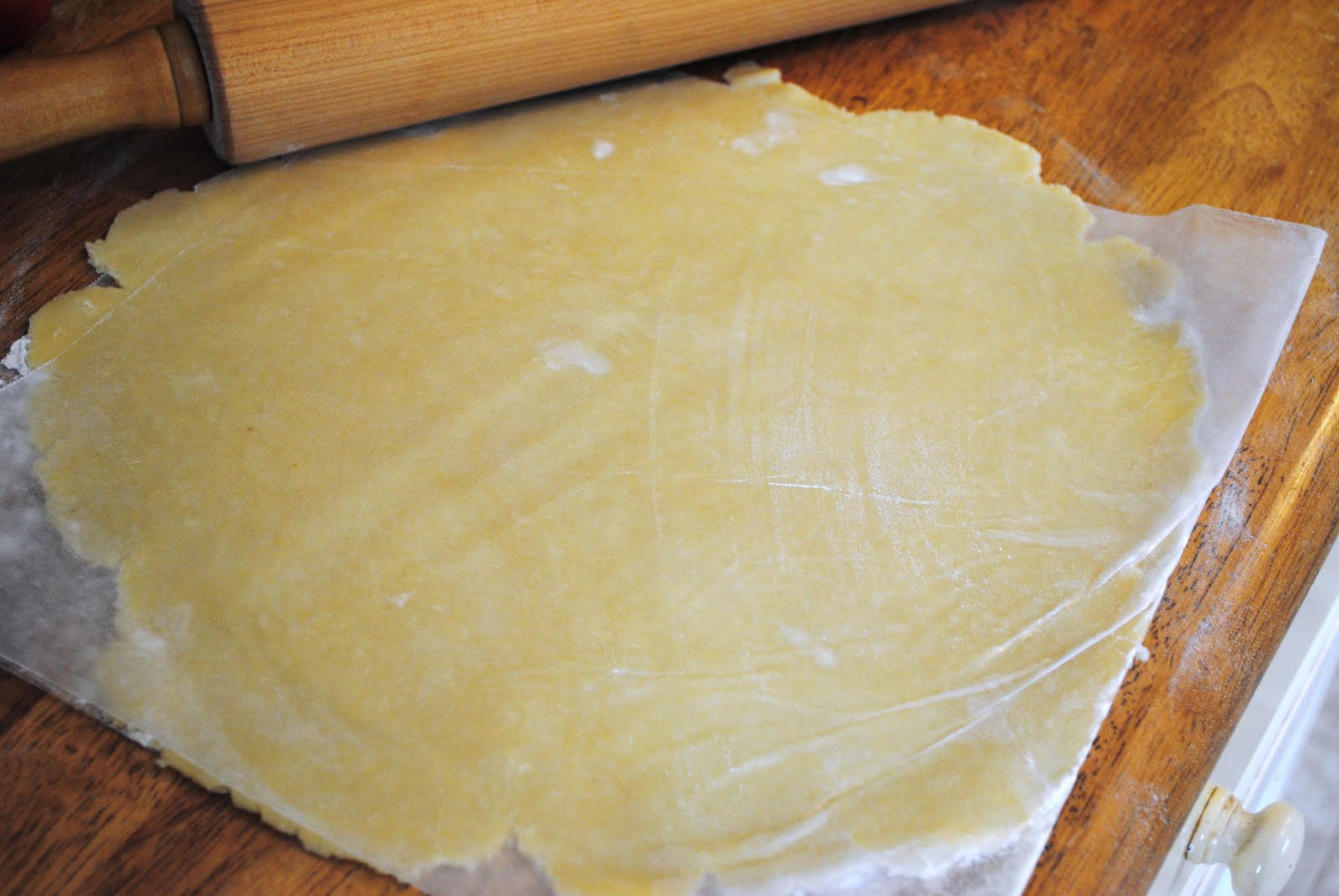
Lightly flour the top of the dough disk, and fold the wax paper over the top of it.  Then, roll out the dough until it is about 10 to 12 inches in diameter.


Once the dough is ready, remove the wax paper from the top of the dough and slide your hand underneath the bottom.  Flip the pie crust into an awaiting pie plate.


Now, remove the wax paper from the rest of the crust, and your mission is complete.


The pie crust is ready for filling.  Since this is just a tutorial on pie crust, you'll have to just imagine what the finished pie looked like.  But if you need a little help, look here.  Don't be afraid to make your own pie crust, it is definitely worth it.  Happy baking!

20 August 2010

Gyro

0 remarks
When Eva was in town earlier this summer, we had gyros for dinner one Friday night.  Once all the components were prepped, we put them all on my wooden cutting board for serving at the table.  It was such a beautiful image, I had to take a picture; and so did Eva.


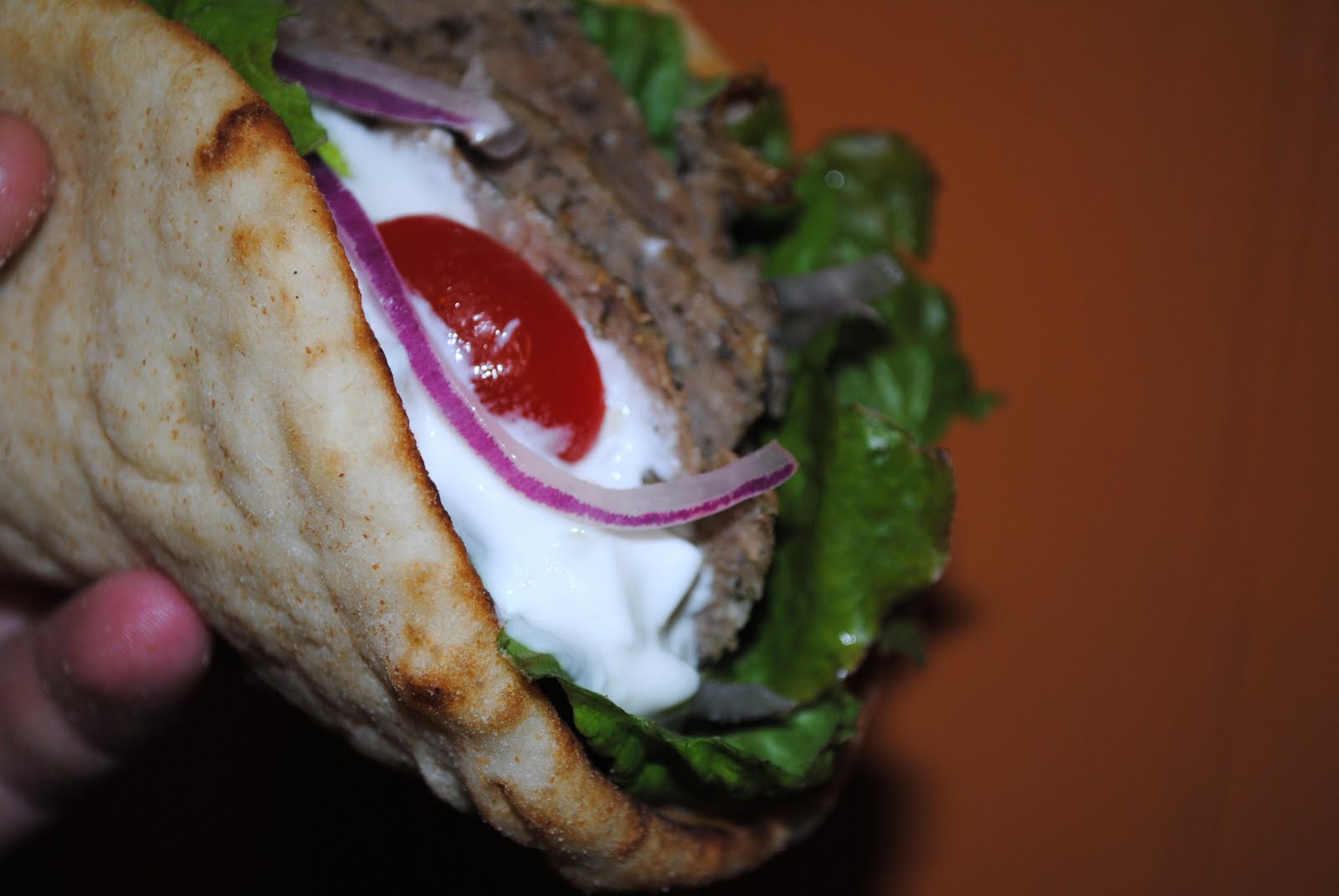
It was such a delicious meal.  Gyros always seemed like something I wouldn't be able to make as a home cook.  Though, thanks to Alton Brown, I am able to make my own, and his recipe does not disappoint.  The flavors are spot on, and it is a wonderful refreshing sandwich. 


As soon as the Good Eats episode "My Big Fat Greek Sandwich" aired in 2005, I knew I had to make this sandwich.  Unfortunately, my grill does not have a rotisserie; but to my relief, Alton Brown included a 'meatloaf' method for preparing the meat.  Lamb is expensive here, so we rarely have gyros; but when we do, it is a real treat.  I can usually count on Angela to request them for her birthday meal.

The preparation for the meat is unlike anything I have ever done.  The method basically consists of making a puree out of the lamb, onion and spices in the food processor before baking it low and slow in a water bath.  The pureed meat is very pink and sticky, and we affectionately refer to it as 'meat paste'; but it does at least smell good.  Once the meat comes out of the oven, the fat is drained and then the meat is compressed further by placing a weight on it.  It really is quite a sight.

It's definitely worth it, though.  These sandwiches are delicious, and we rarely have leftovers.  Alton also has a tzatziki sauce recipe that I always make to accompany the gyros.  His recipe calls for plain yogurt to be drained, but I like using Greek yogurt.  Here's the recipe:

Gyro Meat with Tzatziki Sauce
Recipe courtesy Alton Brown, 2005
Printable Recipe

Ingredients
•1 medium onion, finely chopped or shredded
•2 pounds ground lamb
•1 tablespoon finely minced garlic
•1 tablespoon dried marjoram
•1 tablespoon dried ground rosemary
•2 teaspoons kosher salt
•1/2 teaspoon freshly ground black pepper
•Tzatziki Sauce, recipe follows

Directions
Process the onion in a food processor for 10 to 15 seconds and turn out into the center of a tea towel. Gather up the ends of the towel and squeeze until almost all of the juice is removed. Discard juice.

Return the onion to the food processor and add the lamb, garlic, marjoram, rosemary, salt, and pepper and process until it is a fine paste, approximately 1 minute. Stop the processor as needed to scrape down sides of bowl.

To cook in the oven as a meatloaf, proceed as follows:

Preheat the oven to 325 degrees F.

Place the mixture into a loaf pan, making sure to press into the sides of the pan. Place the loaf pan into a water bath and bake for 60 to 75 minutes or until the mixture reaches 165 to 170 degrees F. Remove from the oven and drain off any fat. Place the loaf pan on a cooling rack and place a brick wrapped in aluminum foil directly on the surface of the meat and allow to sit for 15 to 20 minutes, until the internal temperature reaches 175 degrees F. Slice and serve on pita bread with tzatziki sauce, chopped onion, tomatoes and feta cheese.

To cook on a rotisserie, proceed as follows:

Form the meat mixture into a loaf shape and place on top of 2 overlapping pieces of plastic wrap that are at least 18 inches long. Roll the mixture in the plastic wrap tightly, making sure to remove any air pockets. Once the meat is completely rolled in the wrap, twist the ends of the plastic wrap until the surface of the wrap is tight. Store in the refrigerator for at least 2 hours or up to overnight, to allow the mixture to firm up.

Preheat the grill to high.

Place the meat onto the rotisserie skewer. Place a double-thick piece of aluminum foil folded into a tray directly under the meat to catch any drippings. Cook on high for 15 minutes. Decrease the heat to medium and continue to cook for another 20 to 30 minutes or until the internal temperature of the meat reaches 165 degrees F. Turn off the heat and allow to continue to spin for another 10 to 15 minutes or until the internal temperature reaches 175 degrees. Slice and serve on pita bread with tzatziki sauce, chopped onion, tomatoes, and feta cheese.

Tzatziki Sauce:

16 ounces plain yogurt
1 medium cucumber, peeled, seeded, and finely chopped
Pinch kosher salt
4 cloves garlic, finely minced
1 tablespoon olive oil
2 teaspoons red wine vinegar
5 to 6 mint leaves, finely minced

Place the yogurt in a tea towel, gather up the edges, suspend over a bowl, and drain for 2 hours in the refrigerator.

Place the chopped cucumber in a tea towel and squeeze to remove the liquid; discard liquid. In a medium mixing bowl, combine the drained yogurt, cucumber, salt, garlic, olive oil, vinegar, and mint. Serve as a sauce for gyros. Store in the refrigerator in an airtight container for up to a week.

Yield: 1 1/2 cups

23 July 2010

Blueberry Buckle

2 remarks

So I was watching Good Eats with Eva one night as we were waiting for Daniel and Michelle to arrive from Chicago.  The episode was "Kinda Blue (Blueberry)" and as soon as we turned it on I knew what Alton Brown was preparing on the show, blueberry buckle.  Blueberry buckle!  Blueberry buckle is one of my favorite Alton Brown recipes and I sat there wondering why I hadn't made it for so long.  Right then and there, I decided that when blueberries were in season blueberry buckle would be the first thing I would make with them.

And I did.  I have made it using both fresh and frozen blueberries and I would definitely recommend using fresh if at all possible.  Blueberry buckle is a blueberry lovers dream as it is jam packed with the little blue orbs.  It is not too sweet, and the topping just takes it to another level of culinary delight.  The buckle is wonderful served warm out of the oven, but also holds up well over several days in an airtight container, if it even lasts that long.

I am so glad Eva and I watched this episode because it was a nice kick in the pants to get back on the buckle wagon.  Never again will I let a summer go by without preparing this delightful dish.  As for the other recipes from the episode; I currently have a disk of blueberry pie filling waiting anxiously in the freezer, and I haven't yet made the soda, but it is on my list of things to try.  Here's the recipe for those of you who are interested.  My suggestion, take advantage of the season and give it a try!

Blueberry Buckle
An Alton Brown recipe
Printable Recipe

Ingredients
For the cake:
9 ounces cake flour, approximately 2 cups
1 teaspoon baking powder
1/2 teaspoon kosher salt
1/2 teaspoon ground ginger
2 ounces unsalted butter, room temperature
5 1/4 ounces sugar, approximately 3/4 cup
1 large egg
1/2 cup whole milk
15 ounces fresh whole blueberries, approximately 3 cups

For the topping:
3 1/2 ounces sugar, approximately 1/2 cup
1 1/2 ounces cake flour, approximately 1/3 cup
1/2 teaspoon freshly ground nutmeg
2 ounces unsalted butter, chilled and cubed

Directions
For the cake:
Preheat the oven to 375 degrees F.
Lightly oil a 9 by 9-inch glass baking dish and set aside.
In a medium mixing bowl whisk together the flour, baking powder, salt and ground ginger.

In the bowl of a stand mixer fitted with the paddle attachment, beat together the butter and sugar on medium speed for 1 minute or until light and fluffy. Add the egg and beat for 30 seconds. Add 1/3 of the flour mixture and beat on low speed just until incorporated and then add 1/3 of the milk and beat until incorporated. Repeat, alternating flour and milk until everything is combined. Gently fold in the blueberries and pour into the prepared baking dish.

For the topping:
In a small bowl combine the sugar, flour and nutmeg. Add the butter. Integrate the butter into the dry mixture with a fork until it has a crumb-like texture. Sprinkle the mixture on the cake batter. Bake for 35 minutes or until golden in color. Cool for 10 minutes before serving.

.

12 July 2010

Dulce de Leche

2 remarks

Let's keep this leche train rolling with another recipe from the Good Eats episode "Milk Made".  Dulce de leche.  Milk caramel!  Yum!  I was quite intrigued by this application when I first saw Alton Brown prepare it on my television.  I wanted to try it, but for some reason I hesitated.  I really don't know why it took me so long to finally make this smooth, rich, creamy, milky, caramelly sweet concoction; but I do know it won't take me so long to make it again.

Dulce de leche was really quite foreign to me.  I had seen dulce de leche flavored ice cream, cheesecake, and coffee, but none of them ever seemed enticing enough for me to try.  At the time, I really didn't know what it was.  After seeing the Good Eats episode, I finally knew what it was, but still not determined to try it.  Still, I could not escape the thought of it.  Maybe it was the shot of Alton eating it by the spoonful that kept it fresh in my mind. 

I have never had dulce de leche before this, so I really have nothing to compare it to.  It was easy and simple to make, albeit a little time consuming.  The recipe calls for basic household ingredients and I must admit that added a little vanilla extract when it was done reducing instead of using a vanilla bean.  I am happy with the results, even though I have just eaten it drizzled over ice cream or cream puffs.  I can definitely see how Alton could eat it by the spoonful.  I look forward to expanding the use of it next time I make it, though.  Perhaps I will make a dulce de leche cheesecake of my own.

Dulce de Leche
Recipe courtesy Alton Brown
Printable Recipe

Ingredients
1 quart whole milk
12 ounces sugar, approximately 1 1/2 cups
1 vanilla bean, split and seeds scraped
1/2 teaspoon baking soda

Directions
Combine the milk, sugar, vanilla bean and seeds in a large, 4-quart saucepan and place over medium heat. Bring to a simmer, stirring occasionally, until the sugar has dissolved. Once the sugar has dissolved, add the baking soda and stir to combine. Reduce the heat to low and cook uncovered at a bare simmer. Stir occasionally, but do not re-incorporate the foam that appears on the top of the mixture. Continue to cook for 1 hour. Remove the vanilla bean after 1 hour and continue to cook until the mixture is a dark caramel color and has reduced to about 1 cup, approximately 1 1/2 to 2 hours. Strain the mixture through a fine mesh strainer. Store in the refrigerator in a sealed container for up to a month.

06 July 2010

Tres Leche Cake

3 remarks

Diary lovers rejoice!  Calorie counters hide!
For I have made the Tres Leche Cake!

When I first saw Alton Brown make this cake on Good Eats in 2007, I knew I had to try it myself.  As a self-proclaimed dairy lover, the name alone suggests this cake is definitely for me.  The episode "Milk Made" originally aired on June 6, 2007, so I convinced Angela to let me make it for her on her birthday.  I made the cake and the results were less than desirable.  The cake didn't absorb all of the milk mixture and was somewhat soupy, way too wet for my liking.  Everyone ate it, and didn't complain, but it was not the result I was looking for.  I held on to the recipe but I didn't attempt to make the cake again, nor did I have any requests.  Until...

This year I asked Angela what kind of birthday cake she would like, and to my surprise, she said tres leche cake.  I was nervous to make it, but determined not to let her down again.  I figured I had three more years of cooking experience since the last time I made it, so I should be able to execute it much better than I did last time.  I followed the recipe word for word, and even took the internal temperature of the cake with my thermometer.  The morning of her party, I spread the whipped cream on top of the cake and hoped for the best.

To my delight, the cake turned out much better this time.  It is moist, milky, sweet, and very rich.  A little bit goes a long way, and it would probably be wise to serve it with some fresh berries, which is something I will do next time.  The cake was a hit, and I am happy to share Alton Brown's recipe.  Notice that the amount of cake flour needed is measured by ounces, so if you don't have a scale in your kitchen, get one!  You will not be disappointed.

Tres Leche Cake
Recipe courtesy Alton Brown
Printable Recipe

Ingredients
For the cake:
Vegetable oil
6 3/4 ounces cake flour, plus extra for pan
1 teaspoon baking powder
1/2 teaspoon kosher salt
4 ounces unsalted butter, room temperature
8 ounces sugar
5 whole eggs
1 1/2 teaspoons vanilla extract

For the glaze:
1 (12-ounce) can evaporated milk
1 (14-ounce) can sweetened condensed milk
1 cup half-and-half

For the topping:
2 cups heavy cream
8 ounces sugar
1 teaspoon vanilla extract

Directions
For the cake:
Preheat the oven to 350 degrees F. Lightly oil and flour a 13 by 9-inch metal pan and set aside.

Whisk together the cake flour, baking powder and salt in a medium mixing bowl and set aside.

Place the butter into the bowl of a stand mixer. Using the paddle attachment, beat on medium speed until fluffy, approximately 1 minute. Decrease the speed to low and with the mixer still running, gradually add the sugar over 1 minute. Stop to scrape down the sides of the bowl, if necessary. Add the eggs, 1 at a time, and mix to thoroughly combine. Add the vanilla extract and mix to combine. Add the flour mixture to the batter in 3 batches and mix just until combined. Transfer the batter to the prepared pan and spread evenly. This will appear to be a very small amount of batter. Bake on the middle rack of the oven for 20 to 25 minutes or until the cake is lightly golden and reaches an internal temperature of 200 degrees F.

Remove the cake pan to a cooling rack and allow to cool for 30 minutes. Poke the top of the cake all over with a skewer or fork. Allow the cake to cool completely and then prepare the glaze.

For the glaze:
Whisk together the evaporated milk, sweetened condensed milk and the half-and-half in a 1-quart measuring cup. Once combined, pour the glaze over the cake. Refrigerate the cake overnight.

Topping:
Place the heavy cream, sugar and vanilla into the bowl of a stand mixer. Using the whisk attachment, whisk together on low until stiff peaks are formed. Change to medium speed and whisk until thick. Spread the topping over the cake and allow to chill in the refrigerator until ready to serve.

11 May 2010

Omelet Wars

1 remarks
Upon browsing the Eva + Daniel blog today, I saw that Eva posted a segment of Julia Child making an omelette.  It turns out that Eva learned how to make omelettes by watching Julia Child.  She then visited Latent Chestnut and read the description of Alton Brown's new book.  The description mentions how Alton Brown explains how to make a perfect omelet.  Eva then wondered if Alton Brown's technique differed from that of Julia Child's.  Eva posted a video of Julia Child making an omelette on her blog to show her technique, so I figured I should post a video of Alton Brown's.  Here is an excerpt from "The Egg Files VI: French Flop, Zen and the Art of Omelet Maintenance"


For all intents and purposes, it looks like both Julia Child and Alton Brown use the same technique to make omelets.  One difference is the way they spell 'omelet'.  In true Alton Brown fashion, he breaks the technique down to the simplest steps, but I think the spirit of the omelet and what it is supposed to be remains the same to both chefs.  Check out the Julia Child video on Eva's blog to see if you agree with be or not.  I learned from Alton Brown how to make them, and make omelets quite frequently, actually.  I have perfected the 'one egg' omelet, as it is just the right amount of egg for the kids. 

10 May 2010

Good Eats 2: The Middle Years (Coming Soon!)

0 remarks
Even though I knew it was coming, it doesn't waver my excitement in the least.  In fact, now having owned Good Eats: The Early Years for about 8 months only heightens my expectations for Alton Brown's newest book offering.  Here's the official description:


Good Eats 2: The Middle Years picks up where the bestselling Good Eats: The Early Years left off. Showcasing everything Alton Brown fans (and they are legion!) have ever wanted to know about his award-winning television show, The Middle Years is chock-full of behind-the-scenes photographs and trivia, science-of-food information, cooking tips, and—of course—recipes.

Brown’s particular genius lies in teaching the chemistry of cooking with levity and exuberance. In episodes such as “Fit to Be Tied” (meat roulades), “Crustacean Nation” (crab), and “Ill-Gotten Grains” (wheat products), Brown explains everything from how to make the perfect omelet to how to stuff your own sausages. With hundreds of entertaining photographs, along with Brown’s inimitable line drawings and signature witty writing, this comprehensive companion book conveys the same wildly creative spirit as the show itself.


First of all, I don't think I've ever been described as 'legion' before.  Secondly, I know this book will not disappoint.  Some of the highlights of Good Eats: The Early Years include the elusive pastry cream recipe, and having all the recipes given to us with weight measurements, especially The Chewy.  I can only imagine what I will discover or rediscover in this edition.

Some episodes I am most looking forward to reading more about are "Q" (pulled pork), "The Muffin Method Man" (English muffins), "The Man Food Show" (corn dogs), and "Curious Yet Tasty Avocado Experiment" (avocado ice cream).

I have made the featured foods in all these shows, except for the English muffins, which I am eager to try.  I am hoping to learn something more about the others to increase my success rate.  For instance, I never seem to get the breading right on the corn dog, and my avocado ice cream always turns out really hard.  I am hoping AB doles out some additional pearls of wisdom for these applications so the light bulb comes on in my head.

The book is scheduled for release this fall, and it includes a bonus DVD, too!

10 September 2009

Pastry Cream!

4 remarks
It would be an understatement to say that I have thoroughly enjoyed Alton Brown's new book Good Eats: The Early Years. I have been reading sections of it every night since I got it; digesting all the wonderful nuggets of information thoughtfully placed on it's pages. It is truly a must have for any Good Eats fan, Alton fan, food fan, or really anyone! It's just that good. The book covers the first eighty episodes of Good Eats and is chock full of recipes, fun facts, trivia, and good ol' cooking know-how. So far, I only have one complaint; where's the Stove-top Mac & Cheese?

My excitement for the book grew to an even higher level yesterday when I was flipping through the pages and saw a recipe for pastry cream. Pastry cream? I don't remember that recipe on Good Eats. I turned to the page prior and saw that it was grouped with the recipes from the Choux Shine episode. "No way!" I yelled as I realized what I was seeing. In the actual episode, after Alton makes a batch of eclairs and cream puffs, he tells the viewer to use a pudding mix for the filling. Pudding mix? That doesn't sound like AB. Why would he tell us to use pudding mix? As it turns out, they did not have time to include the pastry cream recipe in the episode and he goes on to say that it really deserves an episode all to itself.

So, why am I so happy to have this recipe for pastry cream? I guess I don't really know. Maybe it's because I felt like the recipe was incomplete. I'm Just Here for More Food doesn't even have a recipe for pastry cream in it. It could be also that I didn't know that the name of the stuff that fills the eclairs is called pastry cream. I was looking for custard and pudding recipes, I didn't know to look for pastry cream. It may also be because I made eclairs a couple weeks ago and my pastry cream turned out lumpy. I didn't really use a recipe because I couldn't find one and just made it on the fly, so I really have only myself to blame. But now my eclair recipe arsenal is complete! Look out world!

LinkWithin

Related Posts with Thumbnails